Pollen, storms and the air outside
Hay fever season arrived, so the dashboard learned about pollen and thunderstorm asthma. Then I had to decide which source gets to say what.

Part of the Home Dash series in The House Project. Start with the story if you haven't. Last updated 20 November 2026.
It's late November in Melbourne's west, which means two things. The grass has gone to seed and half the street is sneezing.
The dashboard already knew a lot about the air inside the house. What it couldn't tell me was what was coming from outside. So this week it learned about pollen, then about thunderstorm asthma. Along the way I had to sort out which source gets to say what.
Pollen, from the people who count it
There are two obvious places to get a pollen forecast. Google has one that covers most of the world from a computer model. And there's AirHealth, a small Australian company started by the people behind Melbourne Pollen, who have been counting the real thing here for years.
I went local. Melbourne's hay fever problem is ryegrass and a global model has no special reason to be good at it. To be fair to both, neither publishes how accurate its forecast is, so that was a judgement about where the data comes from and not a measured result. AirHealth costs a few dollars a month and forecasts by suburb, which is exactly what a wall needs.
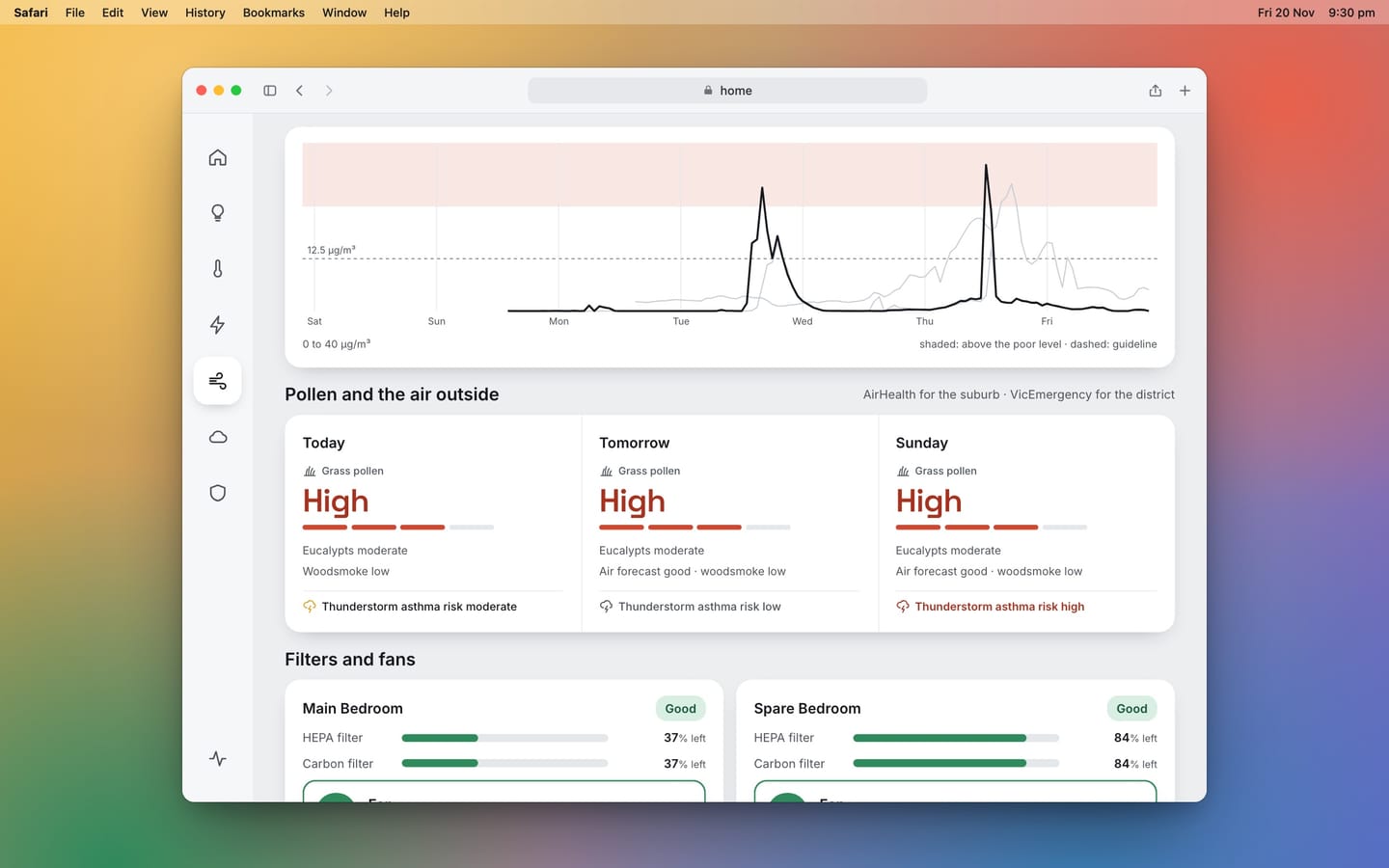
What I get back is plain. For each of three days there's one word for grass pollen (low, moderate, high or extreme), a level for a handful of trees, a weed and a mould, plus a forecast for the outdoor air and woodsmoke.

On the home screen it follows the same rule as everything else there. No pill on a low or moderate day. A quiet white pill when grass pollen is high. A full coral one when it's extreme.
Thunderstorm asthma
If you're not from Victoria this one sounds made up. Under the wrong sort of thunderstorm, on a high pollen day, grass pollen gets swept up, bursts into tiny pieces and comes back down in a rush. People who have never had asthma can suddenly struggle to breathe. Melbourne learned about it the hard way in November 2016.
Since then the state has published a risk forecast every day of grass season, from October to the end of December, for each weather district. It's low, moderate or high. I found it sitting in the public feed behind the VicEmergency website, free and with no key, so Home Assistant now reads it once an hour.

One small decision I like. On a day the thunderstorm asthma pill shows, it takes the place of the pollen pill. You can't have the first without the second, so showing both would say the same thing twice.
This is also the one forecast where being told matters, so on a high risk day Home Assistant raises a notification, both for today and for tomorrow. The night before is when you want to know.
One source per job
Adding a forecast exposed a small mess. The same page now had three opinions about the air outside.
- The EPA's monitoring station a few suburbs away, which measures the air every hour.
- AirHealth, which forecasts it for the next three days.
- The purifier fans, which pull an outdoor number from somewhere on the internet and won't say where.
On the day I looked, the station said "good", the forecast said "very good" and the fans' number disagreed with both. Two words for the same air on one screen is exactly the kind of thing that makes you stop trusting a dashboard.
So each source got one job. The station is the only one that measures, so it owns right now. The forecast owns tomorrow and the day after and is labelled as a forecast. Today's forecast word is left out while the station has a reading. The fans' mystery number is gone altogether.
It's the same lesson as the fan that cried wolf in the design rules. Decide who you believe for each thing and let everyone else be small print or nothing.
What I haven't proved yet
- The government feed uses the words minor, moderate and severe where the public forecast says low, moderate and high. I've assumed they line up. A few days of comparing it with the VicEmergency app will settle that.
- That feed isn't an official service. It's the one their own website reads, so it could change without warning. If it does, the pill simply stops appearing.
- The EPA station near us only reports fine particles and ozone at the moment. The tabs for the other pollutants sit empty outdoors until it reports them.
For now the wall knows when to shut the windows, which is more than I could say last week. How the data gets from those services to the screen is the same plumbing as everything else, covered in what's running it. Every source the house uses is in the kit list.
The occasional email
A few times a year, when there's something worth saying.